
Yoh Phillips
Painted Words
6.10.2026
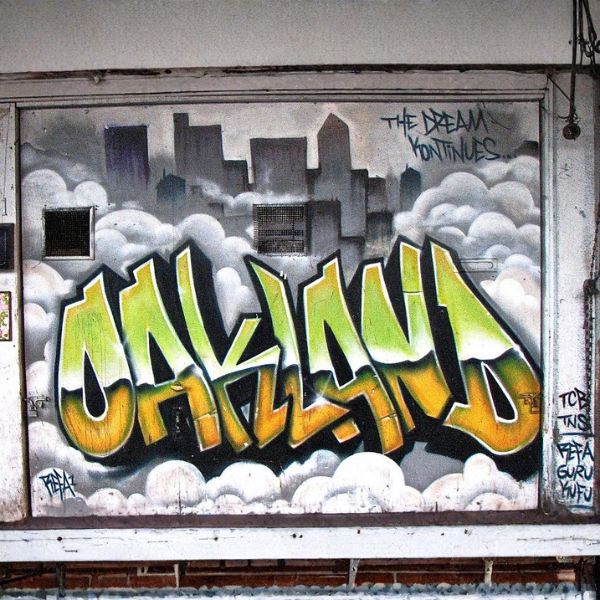
“This is what lawlessness looks like, this is what anarchy looks like,” says YouTuber Nick Johnson while showing Postal Service vans in Oakland, California. This fleet of mail trucks, once gleaming white, red, and blue, is now all tagged beyond recognition in spray-painted bubble letters and fluorescent cartoon characters. Bay Area news coverage of the vandalized vehicles features an Oakland native asking, “Is this my mailman or a Hip-Hop van?”
Meanwhile, thousands of miles away…
Across the Atlantic, in Europe’s largest business district, Paris La Défense, a graffiti exhibition is on display within a 4,000-square-meter, four-floor office building. Created by Antoine Roblot, The Zoo Art Show highlights 500 international artists from 28 countries, all gathered in one place. Junae Brown, a Harlem-born cultural strategist and founder of marketing agency Browned 2 Perfection, said this when asked about the exhibit, “What struck me most about The Zoo Art Show wasn’t just the talent on display, but the respect being given to graffiti as a legitimate and important form of cultural expression.”
When juxtaposed, Oakland and Paris, Nick and Junae, present the yin and yang of graffiti as street art: Order and disorder, notoriety and anonymity, light and darkness. Both sides have lived in contrast, dating back to 1973, when Razor Gallery held the first exhibition for graffiti in Soho at a time when New York graffiti writers were raiding train yards and painting masterpieces by tunnel light. What is it? This artform. An outlaw renegade form of expression or an acceptable medium for high art consumption?
MTA chairman Richard Ravitch viewed subway graffiti like Nick, “a symbol that we have lost control.” Mayor John Lindsay called it an “epidemic of thoughtless behavior.” These opinions have echoed the ages countless times by different actors in different cities. Opposing viewpoints like Village Voice writer Howard Smith was more like Junae, recognizing the art wasn’t thoughtless, and his reporting in praise of graffiti helped subway riders and gallerists Claudio Bruni discover Fredrick Brathwaite and Lee Quiñones of The Fabulous Five crew, which led to The Fabulous Five / Purest Form of New York Art, Europe’s first gallery showing of graffiti writers in Rome.
When you consider the extraordinary careers of graffiti artists Jean-Michel Basquiat and Keith Haring, Banksy, and Belgian Street artist ROA, who all entered the ‘acceptable’ confines of museum spaces, they joined a long line of art movements and honorable artifacts to be recognized and appraised in a positive manner after initially being vilified. Inside this prestigious system, which will honor your name and regard your expression as art, provides access to an economic infrastructure that enables practitioners to earn money, achieve longevity, and build some level of fame. Which raises a question – is it fair that in this designated space, following the acceptance of a designated few, your art can be considered beautiful, creative, and genius? But, if you exit this confinement, are you now an obstruction of justice, a vandal against public decency, and a destroyer of established order? Is this even a binary question?
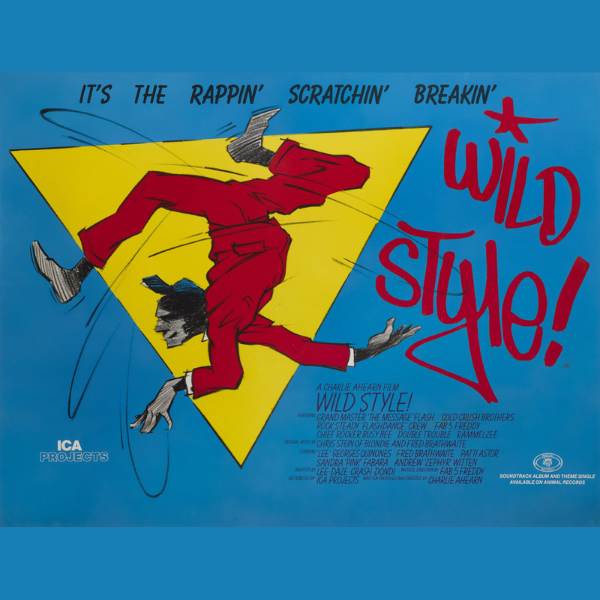
This conflict appears in Charlie Ahearn’s second independent film and Hip-Hop’s famed first motion picture: Wild Style. Wild Style stars Raymond, a young Puerto Rican graffiti writer who paints under the alias Zoro. His pseudonym fits the opening scene: Dressed in black, rope in hand, Zoro scales down a wall covered by a mural that spells ‘GRAFFITI’ in big, brightly colored letters. He crosses a chest-high fence, pauses, and waits, not moving a muscle. The camera stays on him from a distance, like the subject of a verité documentary. This remains true throughout Wild Style. The camera, an onlooker, spies over moonlit rituals, daytime dealings, underground parties, and intimate moments in a world of Day-Glo colors, hissing spray cans, rumbling trains, running pursuers, rhyming rappers, and artistic discussions all happening around a quiet genius coming to terms that the affair between him and his art may cost more than it earns if continued without compromise.
Raymond is played by the aforementioned Lee Quiñones, a real-life incredible painter, who was New York’s most wanted subway writer of the 70s. Shy and stealthy, Quiñones brings a genuine anxiety about publicity to his character. This aligns with the worry amongst purists who believe exposure would be the end of graffiti. Raymond is of their cloth. In conversation with Z-Roc, a writer hoping to get him involved with a graffiti collective that believes graffiti on canvas would interest museums. “They’re making graffiti on canvas? Graffiti ain’t canvases. Graffiti is on the trains and on the walls,” Raymond reacts.
When Raymond meets a Village Voice reporter through a graffiti dealer, he’s invited to party with them and the art world elite. This transitions the street artist to a room of upscale, very affluent, and influential people whose mouths are full of critiques and promises, whose hands are full of business cards and champagne flutes. Raymond looks his youngest and most impressionable when Niva, an older art dealer and the party’s host, presents him with a check for $200 to obtain materials and complete a commission. Their interaction feels like a metaphor for what the traditional museum system can offer the best street artists: Money and supplies.
But, in a later the scene where Raymond is spraying paint on a canvas for the aforementioned work, he appears timid and restricted, as if the compromise has stolen some of his joy. It brought to me the idea I read recently, “What does it cost to enter a world that wasn’t made for you? And once you’re in, are you ever really there?”
Wild Style never concludes Raymond’s story. The movie ends with a beautiful rap jam without ever answering the question: Is it better for the tradition of graffiti to remain an outlaw of the streets or become an art-world artist? Searching for that answer led me down a rabbit hole of graffiti history. I’m left impressed how a form that started with a name (TAKI 183) written on the street morphed into a practice, a practice became a style, and that style went global, beyond the confines of boroughs and subway walls. How should right and wrong be weighed then, when such an expression, that came from disenfranchised youth, who developed their identities by the only means available? Isn’t it a statement to their ingenuity and imagination that a spray can became their paintbrush? That iron and concrete became their canvases?
Time has improved the relations between Graffiti artists and museum curation. Major museums exhibiting the history of graffiti and street art have appeared in the Museum of Contemporary Art, the Brooklyn Museum, and the Museum of the City of New York between 2011 and 2013. Venice Public Art Walls in Los Angeles has been a designated destination for legal graffiti art since 2000. Miami has Wynwood Walls, and Atlanta offers an outdoor gallery the length of ten small cars called the Krog City Tunnel, which continues to attract artists to be expressive without worry. Overseas, especially in European countries, the reverence is even more embracing.
So this brings me back to the initial question – outlaw expression or embraced art practice?
I think of writer Glenn O’ Brien, who wrote one of the earliest stories in support of graffiti for High Times magazine, saying, “Graffiti has a destiny outside the institutions of the art world: to show that art is something that cannot be institutionalized.” One wonders if that destiny has been deferred, if graffiti is only acceptable to the masses when institutionalized.
Artist David Hammons once said about exhibiting art in galleries: “You’ve probably seen more art getting to the spot than you do when you get there,” he critiqued. “That’s why I like doing stuff better on the street, because the art becomes just one of the objects that’s in the path of your everyday existence.”
Will history look back on those Oakland mail trucks and see the start of an art movement not meant for institutionalization? Art that was a part of the locals’ everyday existence, despite not being commissioned by the city. When the subway cars in Wild Style appear on screen, they too weren’t commissioned by the city, but look what came of it?
“Graffiti has always represented more than paint on a wall,” wrote Junae when I shared some of my questions on the subject. “It represents freedom, rebellion, identity, and the courage to be seen. It takes skill to create, but it also takes bravery. To leave your mark, to develop a voice, and to express yourself unapologetically, often in spaces where you’re not invited to do so.”
So I leave it to you the reader, like Wild Style did back in the day. Maybe in religion one finds an answer as Lee Quiñones wrote on one of his most famous murals, “If art is a crime, let God forgive us all.”
My only two-cents – make whatever you do DOPE.
Yoh (Travis Phillips) is an Atlanta-born music journalist and author of the hip-hop anthology Best Damn Hip-Hop Writing: The Book of Yoh. His work has appeared in DJBooth, Mass Appeal, and The Hundreds. He co-hosts the Southern hip-hop podcast Sum’n to Say and is executive producer of the documentary series Rap Portraits. Known for engaging, daring criticism, he frequently discusses hip-hop’s blog era and his nostalgia for Limewire.