
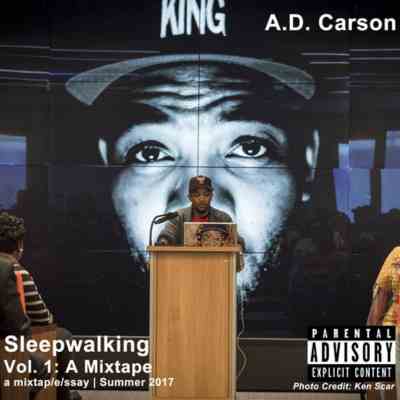
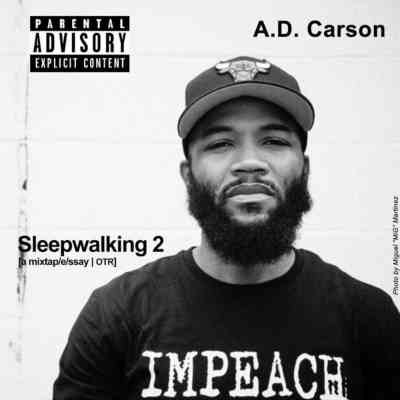
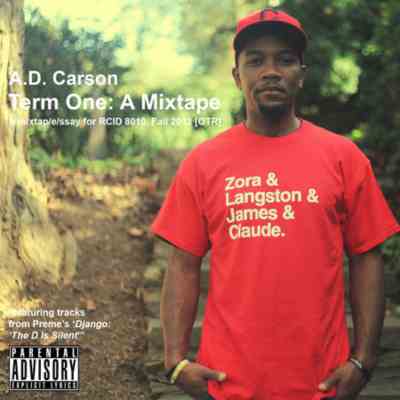
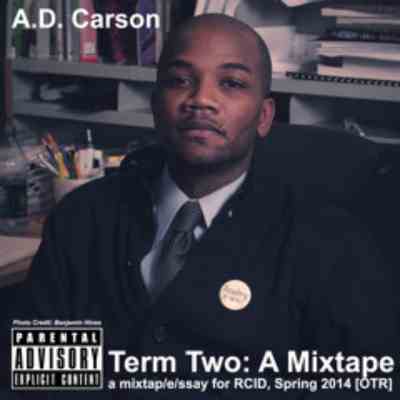
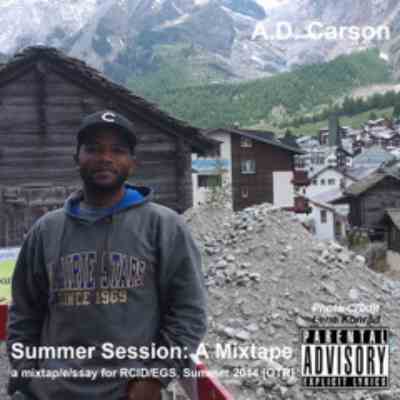
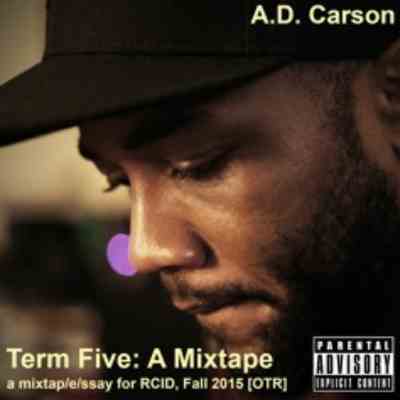
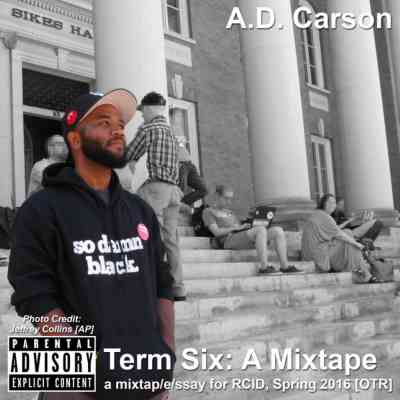
A.D. Carson Bio:
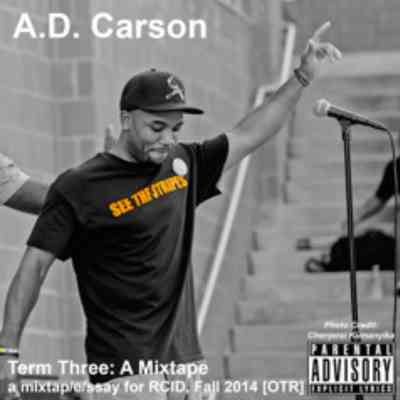
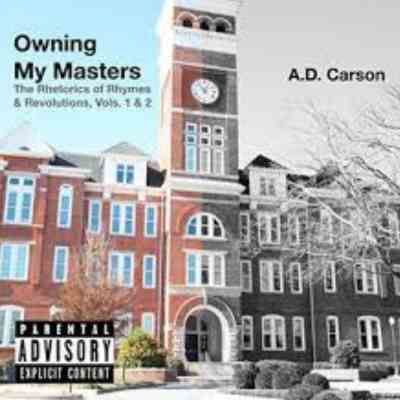
A.D. Carson is an Associate Professor of Hip-Hop and a Shannon Center Fellow for Advanced Studies at the University of Virginia. He is from Decatur, Illinois. His work as a performance artist, educator, writer, and commentator deals with issues of race, place, history, literature, hip-hop, rhetorics & performance. Dr. Carson is suspicious of academia and academics, but he earned a Ph.D. in Rhetorics, Communication, and Information Design at Clemson University in 2017 by submitting the rap album, Owning My Masters: The Rhetorics of Rhymes & Revolutions as his doctoral dissertation. https://aydeethegreat.com/
You’re originally from Decatur, Illinois. What was it like growing up there? Was there a hip-hop scene?
A.D. Carson: Absolutely there was a hip-hop scene in Decatur though I can understand the uninformed view that this is absolutely not a place where hip-hop lives or where hip-hop communities thrive. But that couldn’t be farther from the truth. Not only were there hip-hop communities, there was something strange about being in the center of Illinois because it’s not quite Chicago, it’s not quite St. Louis, it’s not quite Carbondale. it’s not quite Memphis, but you feel the influence of all of those places among such a small population.
There was a record store called GB’s. All of the albums I ever released, I would go to GB’s, give them 10 copies and they had an envelope up front where they would give you whatever you made. They would generally not charge you to do consignment. and there were weekly battles, regional battles where Champagne, Decatur versus Peoria, Decatur St. Louis, those kinds of things went on. There were groups when I say robust, it was an incredibly robust scene. I spent a good portion of my childhood, going to house parties, I was shorter than five feet, all the way probably through middle school. People couldn’t see me over the turntables and I’m just standing back there rapping. My older brother often would take credit for writing my raps or he would go out and perform my raps because nobody could see me.
That proximity and that energy that was always there. And I think that it remains there even today. When I was in Decatur two weeks ago, I watched a few of the acts from I’m assuming what was their hip-hop stage and they were dope. Sad that there weren’t more people there but excited that there’s still dope music that’s being made at the street level whether people see it as commercially viable or not because I don’t believe commercial viability is the only arbiter of what hip-hop can do and I imagine that my career and my life is kind of a testament to that.
Who were your main influences – artists who’s style you copped, flows you wanted to emulate, and/or a style you wanted to rock when you were creating your own lane?
Being from the Midwest makes my influences seem eclectic by the standards of mainstream understandings. There are Chicago artists like Twista, Common, and Psychodrama, folks like Top Authority, M.C. Breed, J-Dilla and Royce the 5-9 from Michigan, but I was also influenced by groups like 8Ball & MJG from Tennessee along with all the acts signed to Suave House and West Coast rappers like Spice 1 and Tupac.
Thoughts on being a professor? Many have claimed – inaccurately – that they are just that. What does it truly mean to be a professor of hip hop and what work do you need to put in to claim that title?
I’ve written about the perils of hip hop repeating the flaws in American history by trying to make everything sensational regardless of what’s literally true. I have also written that I think there should be more hip hop in our schools at all levels including professors. That will likely look very different from person to person just like hip hop varies across the country and across time periods. Racing to take credit for who did it first feels colonial. I’d rather it be done ethically and responsibly than rushing to claim to be an innovator. That said, I’ve tried to be deliberate in releasing my music and my publications in ways that are accessible and approachable. I don’t think a person needs to have a Ph.D. to be a professor or to teach. In fact, part of the reason I went to get a doctoral degree was to be able to say, from experience, how it might be beneficial or not. But that doesn’t mean that my credentials should be ignored, though. Becoming a doctor by making rap music is an important feat.
Thoughts on the many Hip Hop artists that have relationships with Universities? Not that we are hating on them – its always a good look to want to self-improve and show out – but from your perch, what is your take away?
This is kind of answered in the previous response.
When people say that hip-hop is dead, how does that strike you, knowing that there are these smaller communities out there that have that scene?
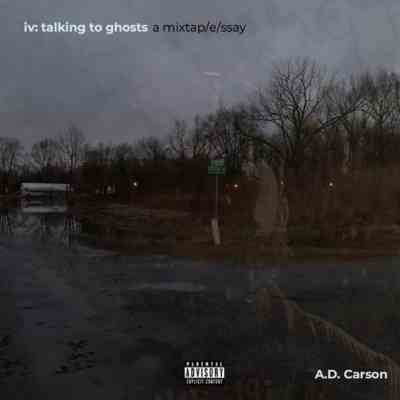
A.D. Carson: Every time people say that hip hop is dead, I remind them that we’ve spent a long time culturally talking to ghosts. When a person makes that kind of pronouncement, I think maybe they’re saying it to be provocative or they’re saying it to get a rise out of somebody, but I don’t think that comes from any real place of understanding. Hip-hop culture is kind of the product of what we might understand after lives. And I’m saying that rappers are often speaking to people who are no longer physically here, carrying on traditions that seem to have gone by the wayside, channeling ancestral forces. And I don’t mean that in any kind of metaphysical way. What I’m saying is that you can make the direct connection over generations to these older oral traditions that helped people document what life and livingness was. So saying that hip-hop is not going to die, that’s not even real. People who are trying to kill it are, often probably trying to do a kind of gatekeeping that hip hop is always evaded even if the people doing the gatekeeping felt that they were credible or had whatever authority bestowed upon them to be able to make those proclamations.
Quest Love said something about it. I wrote a review of this book during the same summer he posted something on Instagram saying hip hop truly is dead. And my response to that was again, we talk to ghosts over here. That doesn’t put me off because it also doesn’t stop what’s going on in all of these communities all over the world. What do we do with the thing that is alive or that is at least walking around animated and continuing to produce? Do we treat that as a zombie? Treat that as the undead? You can’t really make sense of that if I’m in Ireland and I see a B boy crew and I’m in a club and I didn’t even know that there were B boy crews in Cork Ireland. What’s going on here? That’s evidence of something. I don’t think that nobody that I respect would seriously say that and expect for me to not push back.
The Raw Offices: How do you feel about the conversation about starting a new category in Hip-Hop called adult contemporary? What’s your feelings on that?
A.D. Carson: A conversation about categories is a conversation about genres which I’m fascinated with. I feel like maybe we’ve lost the plot on that as well. Genres are not something that I’m ever thinking about when I’m standing in a room with people making or listening to music. There’s awareness of it but as a scholar, you go back and say okay how did we get from the beginnings of pop music in America to something like urban contemporary or R&B and trace that trajectory. I wrote an essay for Washington Post about tracing that trajectory.
The history of black music in the United States goes absolutely from blackface minstrel songs, all of this kind of stuff through records doing what they first called race records and then those records being deemed rhythm and blues. Tyler the creator was saying having his album be called urban, being code for that holds up to academic scrutiny that historically, yes, these genres are racially loaded and they are ways that we’re able to either signal who is buying the music or who’s making the music. The idea of a new category, it comes in a new light. I’m not saying that I would be categorically for it or against it. Whenever you make that category, we have to be explicit about what we’re doing it for. It seems like we would be doing it for this very old thing, trying to make the music correspond to the bodies of the people we assume are buying it or who we assume are making it. It’s our inability to reckon with what it means to age.
Q-Tip once said, ” I don’t like calling it adult contemporary hip-hop. Why don’t we call it traditional hip-hop?” How would you feel about that instead?
A.D. Carson: There’s an essay on the conversation that I wrote, about ageism in hip-hop, this will be in my book. The way that I’m trying to frame it is that all of the labels are going to be beholden to the rhetorical ground that we’re already on, making it seem as if genres are natural and have always been here. They haven’t always been here, are absolutely not natural, they aren’t neutral, and aren’t things that we necessarily need. But our treatment of it, makes us incapable of imagining what could be because we’re so stuck on what we believe always has been. It doesn’t matter to me what people call it because my relationship to music making and being in the public eye is different. As our relationships to music change, and I imagine that this is for a lot of artists, folks aren’t trying to get on radio necessarily anymore, which was an exclusive format in codified genres or crystallized genres as we know it. Radio is one of the ways that some of these titles and genres have crystallized that adult contemporary means something to radio, to the markets that those people are trying to get advertisers to support. If that’s not here anymore then we can do something different. It’s a perfect time as technology is shifting for us to think differently about whether we should carry these buckets over into whatever it is that we want to imagine that might be better for music and musicians.
Alright, let’s have some fun. Start. Bench. Cut. What’s your order for MC’s and why?
· Black Thought, KRS, and Rakim? This one is easier because of the distance in time between the artists. I would start Rakim, bench KRS and cut Black Thought. This has less to do with who I think is better than the fact that there may not be a Black Thought without the existence of KRS and Rakim. If they are the starter and bench, then that leaves room for a Black Thought in the future.
· And – for the new cats – Kendrick, J. Cole, Tyler the Creator. These are horrible choices since they’re already all starters. My inkling would be to put Noname and Saba in the game here.
· And can’t forget the ladies – Doechii, GloRilla, and Lil Sims. Again, bad choices—women aren’t playing in a separate world of art. I think all three of these artists would be better choices than the ones listed in the previous question. If the metaphor for start, bench, cut is to win, then I think Doechii and GloRilla are a winning team at the moment. No hate or shade to Cole, Kendrick, or Tyler.
For someone first discovering you, is there a particular song or an album you would direct somebody to go to?
A.D. Carson: Nah, I wouldn’t. Owning My Masters volumes one and two are the most recent, though. I’ve been writing a new project that I’ll probably release within the next couple weeks [in fact – it has now come out!]. The playlist from my dissertation album, Owning My Masters, all the way through the mastered version of that album, are numbered consecutively. And the reason that they’re numbered consecutively is because I feel like I’ve been working on the same project the past 10 years.
What you’re hearing is iterations of moments where I’ve been able to collect my thoughts and then drop them as a placeholder in 2017, 2020, 22, 23 and that has been very deliberate for me. I think that we do well to deliberate over music a little bit more, to sit with what somebody has been saying for a while. So if someone says, ” we need a new song about politics or we need a new song about the political process but what have we done with the previous one?” We haven’t contended with that. The utility of music is not just the use value for its newness. I imagine that Marvin Gay’s what’s going on is as relevant now as it was whenever it was written. How we feel about certain things that are older, have a little bit more distance. In the realm of content creation, we want everybody to give us something new every day. If I post on any of my socials something that I posted two or three weeks ago, folks are engaging with the expectation that it’s a new thing. I have to be prolific and it’s as if I don’t have any freedom to ask people to sit with the music or content, sit with the ideas. That’s part of what I’m doing as well, to try to slow that process down because every meal is not meant to be consumed, every meal is not meant to be consumed in butcher paper or greasy bag while you’re sitting in your front seat, driving off from the drive-thru. Some meals you need to get out the car. You need to put your napkin down. Bless your food or you give thanks, then you need to do that. Taste, you go through the appetizers, you go through the courses. I feel like we should make more time for that. We should make more time for a different kind of consumption to listen deeply, listen slowly, all of those things.
Any other new projects to look out for?
A.D. Carson: The new album I’m calling it “For Immediate Release” will be out in a couple of weeks. It’s new music as well as commentary analysis. I’ve got interviews that I’ve done with international media or other places where folks who listen to my music might not be able to hear what I said on NPR.
Mix those together so people will be able to get the full breadth of what I’m trying to do. I think that my music is theorizing, but folks who are against thinking that rap music is a way to provide commentary, analysis, and theory, they want to see you write it in an essay or talk about it on a podcast. The project is really to make room for people to understand what the book is going to do. The book is coming from Oxford University Press through their theorizing African-American music series. That’ll be out in the fall of this year. I’ll continue with the features and just try to make shit wherever I can however I can, persistently trying to make sure that my aura is in the conversation that is going on. There’s so much information out there that needs to be challenged. So much that needs to be deliberated over, so much that we really need to have folks who feel a responsibility for and about hip hop to make sure that our cultural inheritance is in good hands with the generations of people who are coming up listening and learning to love and hate it.
It was so great to meet you. Thank you for doing this. We wanted to say congratulations on all your accomplishments and success. The world needs guys like you who put the education in hip-hop, too. This is the first time I’ve ever talked to a hip-hop professor, this was amazing. Dr. AD Carson, it was a pleasure.
A.D. Carson: I appreciate y’all. Yeah, thank you.