
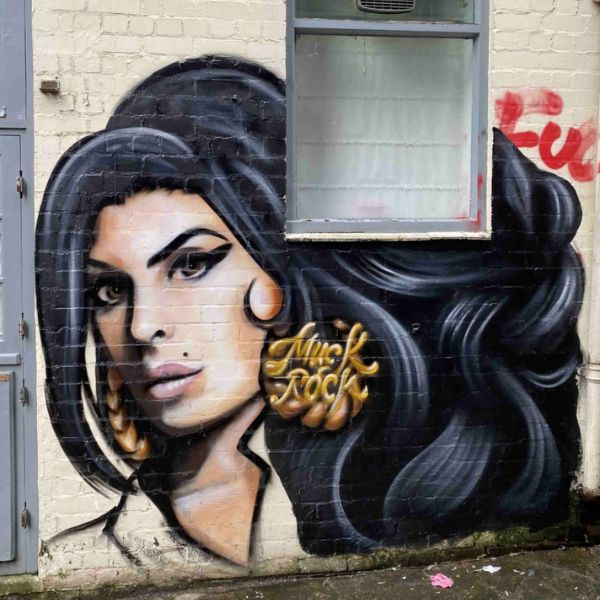
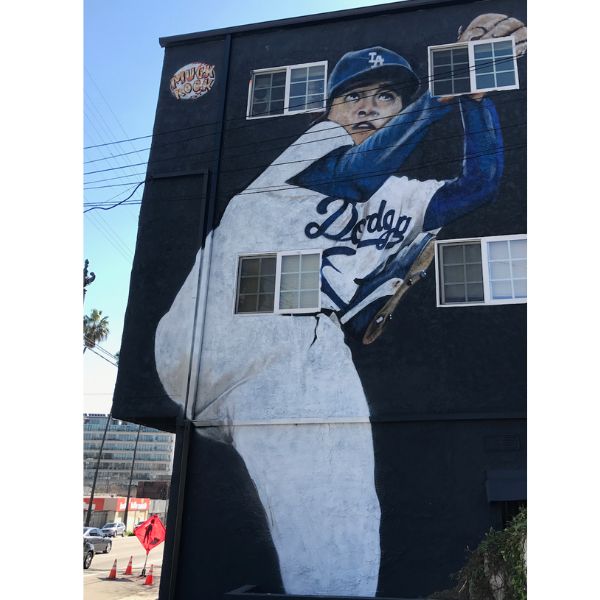
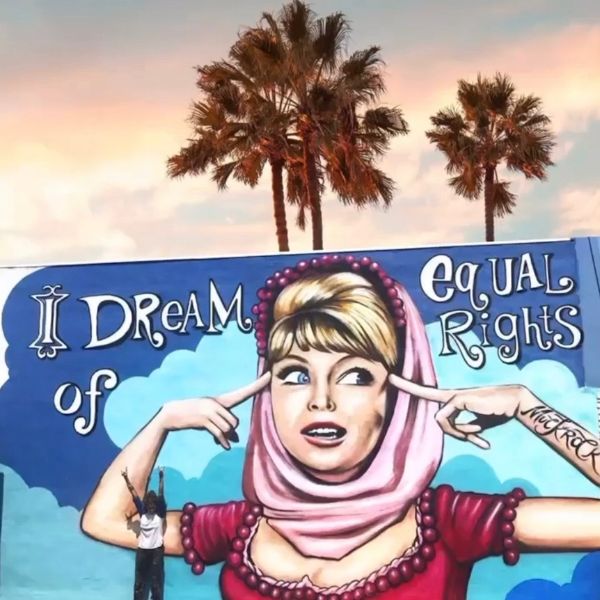
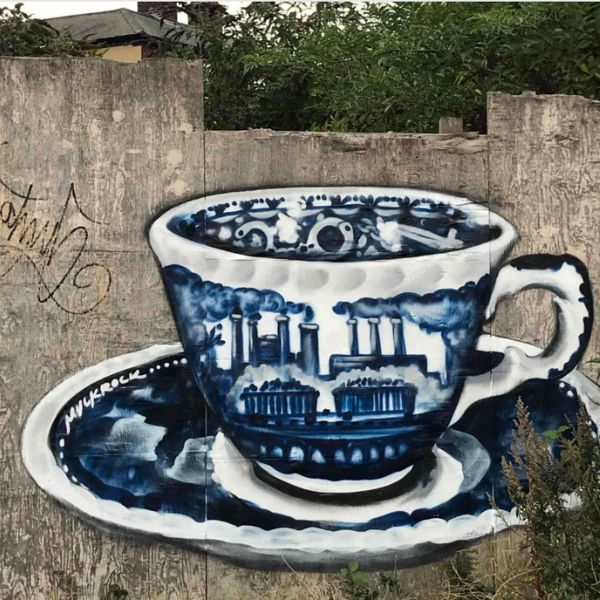
Long before her murals became iconic pieces visible across Venice Beach, Chicago, New York City, and across the world, Jules Muck was just a kid tagging alongside highways, under bridges, and atop abandoned rooftops, her work fueled by rebellion and self-expression.
In Muck’s early years, graffiti was nothing more than a hobby– she didn’t see it as something that could one day turn into her career. “My early beginnings were mostly tagging. I didn’t think I was a good artist. I just thought it was fun to put my name on stuff, and slowly, I developed some kind of pride in my work,” Muck recalls. The first tag that she can remember is the word “Unity” painted in bright orange hardware store spray paint on an island wall. To her surprise, it came out looking better than she had anticipated, encouraging her to keep experimenting with spray paint. Her formative years were greatly shaped by her experiences living in different countries, each city leaving its mark on her creativity and expression.
Born in Stoke-on-Trent, England, a town rich with craftsmanship and its pottery industry, Muck grew up with art and creativity all around her. “The UK was a fun place to paint,” Muck says. “I had good company there with other artists, and I still love to go paint there. They embrace street art.” In Greece, she began painting with a small crew named “Suicide Crew” (said in a heavy Greek accent), learning from other creatives who had more experience, honing her craft in a collaborative environment. While Muck had spent her early years as an artist painting in a variety of spots with different crews, it was her time in New York that was the true turning point. There, during her time while painting with BTC (Bronx Thug Connection), her graffiti hobby began to transform into a career.
The Path to Success
One day, while painting on top of an abandoned rooftop off Intervale Ave in the Bronx, her work caught the eye of Lady Pink, a female pioneer in the NYC street-art scene. Lady Pink recognized Muck’s talent and offered her an apprenticeship, where Muck recalls earning $100 a day—her first paid art job and her first real moment of self-belief as an artist. “I believed in myself because she believed in me—she taught me to believe in myself. I didn’t think I could be an artist. I didn’t even think I could do anything, but when she told me to do it—though I did it more out of fear than anything else—that’s when I knew that I could do this,” Muck explains. Even now, after all of this time working as a successful muralist everywhere from Bristol to Mexico City, Muck still has her doubts: “Even working on my own, today, 30 years into it, having bought properties, having traveled the world, and having painted for so many people, I still wonder: is this going to work?”
One of the lessons of Lady Pink that stuck with her the most: “You can’t teach style,” a line that stuck with Muck’s approach to individuality when working as an artist. Muck faced feelings of personal struggle when transitioning from creating illegal artwork to becoming a commissioned artist. There was a certain sense of vulnerability that came with making this type of work. “Really, the hardest part about incorporating large-scale, detailed murals that cost money into a graffiti landscape is that your work becomes vulnerable. It’s not quick; it’s not carefree. It’s painstaking,” she explains. Each new project she tackled required not only technical skill but also the courage to reveal herself fully through her work, all while still appealing to the commissioner.
Struggles and Resilience
After years of working in New York City, the next chapter of Muck’s journey took her westward to Los Angeles in 2008, as she believed the art scene there was more conducive to her style of work. With little money, no network, and the challenges of a sprawling and unfamiliar city, Muck faced a period of extreme uncertainty. When her roommate bailed on her, she drove her car until it ran out of gas, winding up on Electric Avenue in Venice Beach. Despite having no work and no place to live, Muck was determined to see this next chapter through, resorting to living in her car in Venice. Those early years in Los Angeles were a true test of her perseverance, painting whatever and whenever she could, just trying to get her work out into the city. The local community played an unexpected but crucial role in her journey. Residents and fellow artists offered workspace, co-signed leases, and encouragement, helping her navigate her new environment and establish herself as an artist in a new city.
In Venice, Muck discovered an audience receptive to her energy and storytelling, a community that valued murals not just as something visually pleasing but as narrative expressions with cultural and personal significance. Venice has always inspired Muck. “There’s something about the energy here, plus I think my style is welcomed here, and so I’m inspired to do more public art,” she says. The eclectic energy of the community, combined with its embrace of public art, provided ample opportunity for Muck to expand her creative presence.
Although Muck was slowly building herself as an artist in Venice, Muck still faced personal challenges—financial uncertainty and the lingering battles with addiction and mental health struggles. These obstacles could have derailed her journey, but Muck continued to lean on her art as a source of resilience and hope. Painting became both a personal anchor and a lifeline, an opportunity for her to process the dark periods of her life, transforming hardships into creative expression. Battling mental health struggles and addictions, art acted as a form of faith. “I see God in what I paint… It’s a spiritual thing. It’s a connection, it’s magic, and I love it, and it makes me feel better about everything,” she states. For Muck, creativity is inseparable from the act of healing. Her commitment to turning art into a tool for healing extends beyond herself. During the COVID-19 pandemic, Muck founded Muck Recovery, a sober hangout group for artists, which eventually evolved into a support group and safe space for creativity and self-transformation, offering 12-step meetings and recovery workshops. The program provides an environment for people to confront addiction and mental health challenges head-on, using community and creative expression as a way of navigating their healing journey. “Art definitely cures my mental stuff—better than any meds. Lots of artists turn to drugs and alcohol to deal with mental illness. It’s helpful to have a sober community of other creatives to turn to,” she explains. Through her mentorship and public art, Muck has created avenues for other artists to find both healing and inspiration.
As for her creative process, it consists of a mix of planning, collaborative input, and spontaneity. “Sometimes we share thoughts and ideas with the people involved,” Muck says, describing how she begins projects by connecting with clients, community members, or collaborators to understand their vision and help bring it to life. She often gathers research as well, gathering photos for reference and further understanding of her subject. All of this helps shape the narrative or tone of the piece. Yet, not everything is always mapped out. Much of Muck’s work retains the spontaneity that first drew her to making street art. Her murals often evolve on the wall as she goes, responding to the physical space, the surrounding environment, and her own instinctive ideas. Oftentimes, Muck’s murals have been altered by local artists of various communities. Rather than fight these circumstances, she finds herself at times returning to these murals, working with the changes, and transforming the space into a dynamic, interactive, and continually evolving work of art. This flexibility allows her pieces to feel alive and integrated with the neighborhoods they inhabit while still maintaining true to her signature style.
A prime example of this resilience was her mural in New Orleans, “The Money Wall.” The piece featured historical figures from U.S. currency, depicted with thick gold chains to symbolize the deep intertwining of money and power. When the wall became a target for local artists, Muck chose not to erase the defacement. Instead, she treated the vandalism as a chance to communicate with the community. When a portrait of Lincoln was tagged with the phrase “I got 5 on it”—a nod to the five-dollar bill—Muck swiftly incorporated the text by redesigning the figure’s jacket to match the new energy. As the tagging continued, she allowed the mural to emerge from these defacements, turning the wall into a living collaboration between herself and the public. This flexibility allows her pieces to feel integrated into the neighborhoods they inhabit, acting as a testament to the complicated, ever-shifting relationship between art, history, and the community.
When it comes to selecting projects, Muck is guided by both practicality and inspiration. “If I have time, I usually try to do whatever murals come along,” she states. While she considers audience, location, and meaning, her approach is grounded in a desire to create whenever and wherever possible, letting each project contribute to the ongoing dialogue between her work and the various communities she serves.
Chicago Work
Chicago has offered Muck a space to further explore different styles and engage with local communities. Her early projects in Chicago included work for the Lucky Strike bowling alley, painted during one of the infamous Polar Vortex winters. Despite the cold, Muck’s creativity thrived, producing a mural that embodies Chicago’s resilient energy and her own unrelenting dedication to her work. Even in subzero temperatures, Muck found inspiration in the streets and Chicago itself, exploring different nooks of the city late at night. “Some pieces were legal, some weren’t. I painted illegally by rivers and hung off overpasses. Every time I come back to Chicago, I paint more,” she expresses, emphasizing the freedom and energy that shaped her work in the city. Neighborhoods like Pilsen, known for its vibrant Latin American culture and street art heritage, had a profound influence on Muck’s murals. Here, she painted for restaurants, local businesses, and community organizations, often incorporating cultural iconography and storytelling into her work. These murals were not merely decorative; they celebrated the histories, identities, and voices of the communities she worked in.
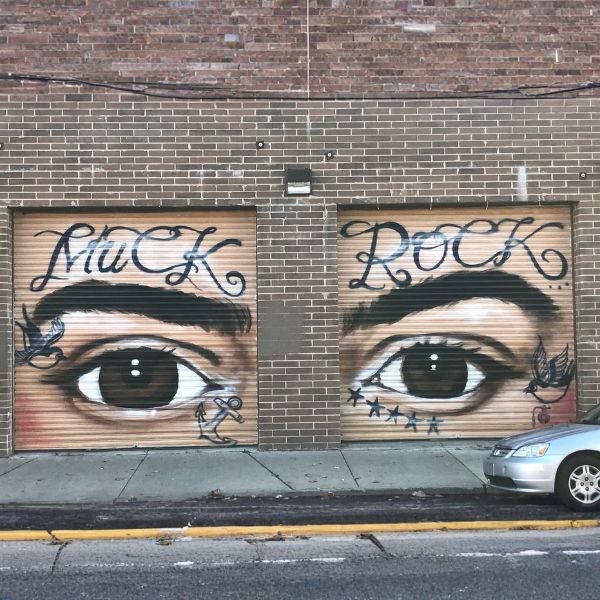
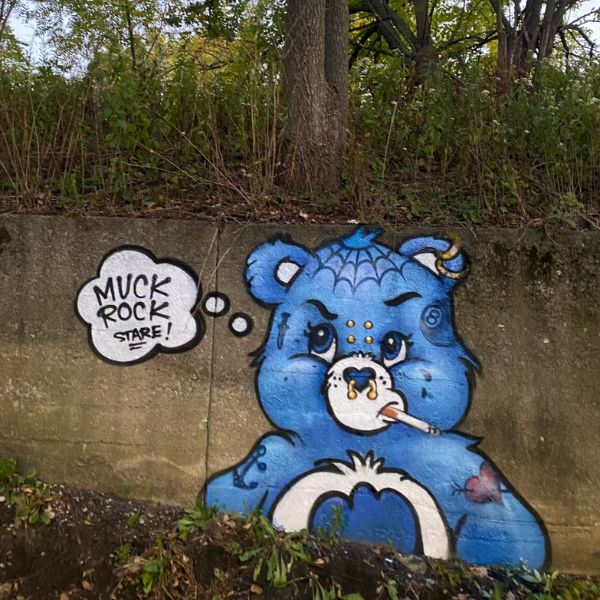
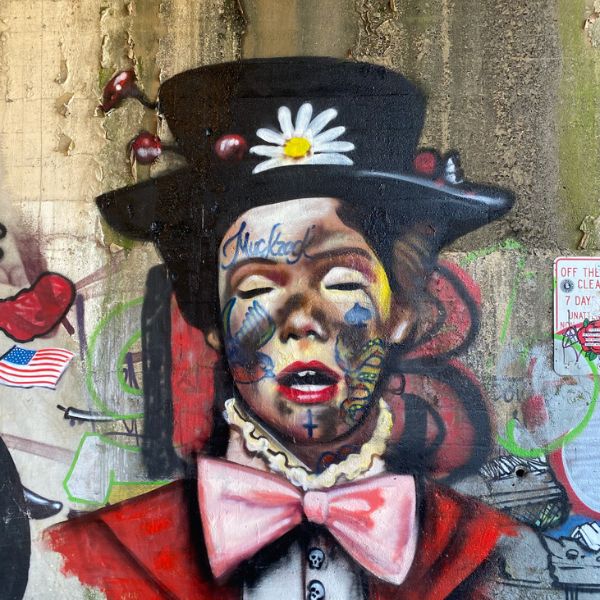
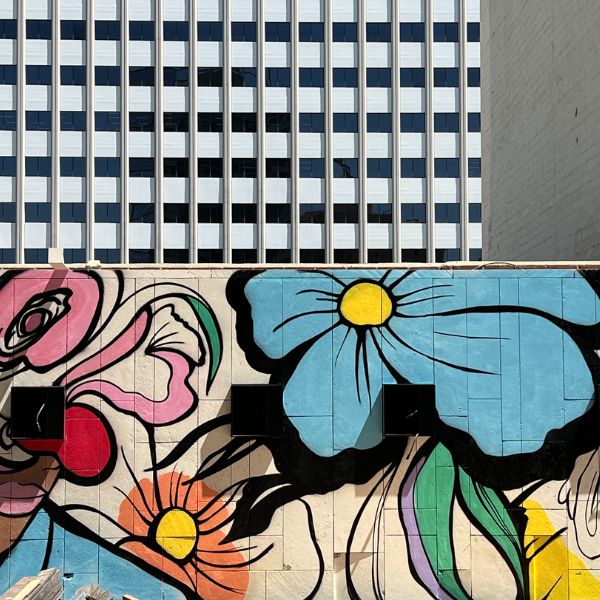
Muck also found creative opportunities at the B Line, the iconic mural district in Fulton Market that has become a hub for street art and public expression in Chicago. The area provided both exposure and collaboration with other artists, allowing Muck to experiment with scale, composition, and different techniques. From Pilsen’s vibrant streets to the B Line’s mural spaces, Muck’s Chicago work exemplifies how street art can both honor and challenge its surroundings. Each piece tells a story—of place, of people, and of herself—all while contributing to the city’s street art scene. One of Muck’s most recognizable works in Chicago is a vibrant portrait mural of Mary Poppins, painted in the B Line District, a popular spot for artists to create mural work. Other works include the “I Don’t Care Bear” and “Frida’s Eyes” murals, which further showcase Muck’s range—from satirical pop-culture reworkings to deeper, emotive portraits inspired by cultural icons. Both pieces balance bold color and personal storytelling, alongside humor and playfulness, showing her range of style. In Muck’s “Not 4 Sale” mural, located in a rapidly gentrifying neighborhood near East Village, Muck addresses the displacement that locals experience when there are transformations happening in urban spaces. The piece serves as both a sign of resistance and preservation, acting as a reminder that art and authenticity shouldn’t be erased. Similarly, her restaurant murals across the city continue her commitment to community-based art, transforming everyday spaces into vibrant galleries that celebrate the culture and identity of the people who make these spaces what they are.
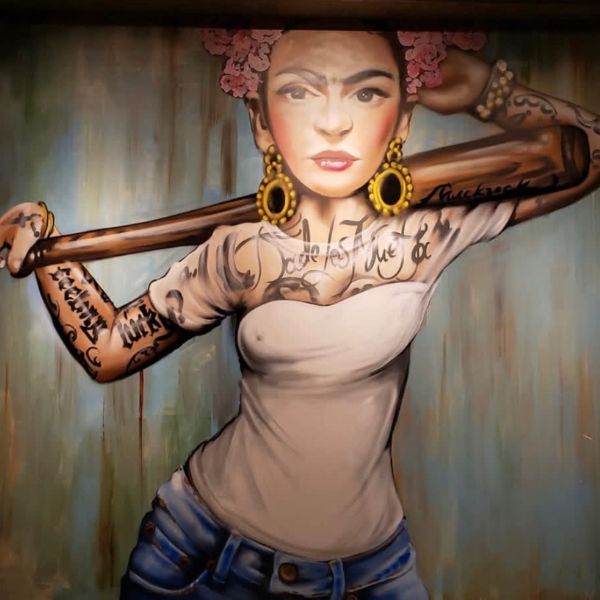
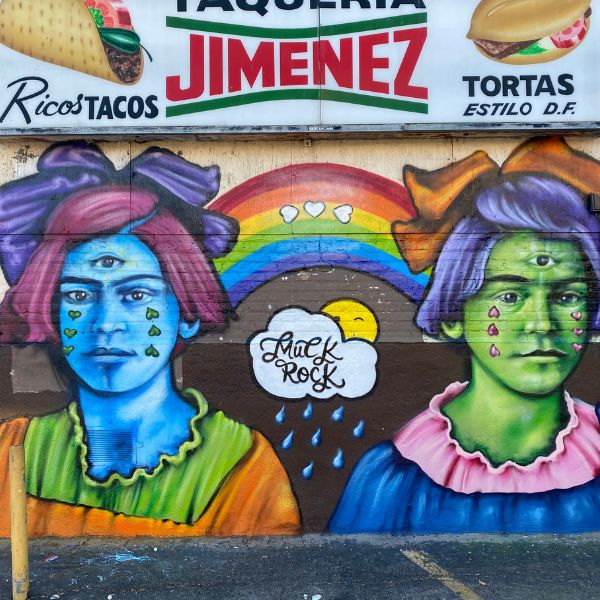
Another standout mural from her time in Chicago can be found in Hermosa, at Jimenez Tacos, where Muck created a playful and vibrant reinterpretation of a young Frida Kahlo. This piece acts as a joyful nod to Latin American identity in a Chicago neighborhood rich with cultural history. Muck’s interpretation of a young Frida does not express her typical solemn expression—instead, her version shows an alive, expressive, and slightly mischievous Frida, capturing the spirit of a community that thrives on creativity and resilience. The mural reflects Muck’s deep appreciation for the spaces she paints in, drawing from the history of the neighborhood to relate and celebrate its people. When asked if she would like to return to Chicago to paint, Muck says, “Always, and anything!”
Recent Projects: Life and Death
Most recently, Muck’s creative journey has led her to Mexico City, where she recently completed murals for the Museo del Juguete Antiguo México, The Toy Museum. This current era of work draws from her personal life after experiencing loss. Specifically, these pieces of work are a testimony to the recent passing of her father, drawing inspiration from the Greek song that she played for him as he was dying, “To Teleftaio Vrady Mou,” which means “My last night,” which touches on the themes of life and death. The lyrics in the song state that “life has two doors,” expressing how we enter through one door (birth) and eventually leave through another (death), conveying a sense of transience—that all of us are just passing through life. The doorways in her latest murals in Mexico City represent the unknowns of mortality, inviting the viewer to use their beliefs and imagination to fill in the rest. “That’s the greatest thing about art,” Muck reflects. “We don’t have to have a photo of it—we can just discover it as we are painting.”
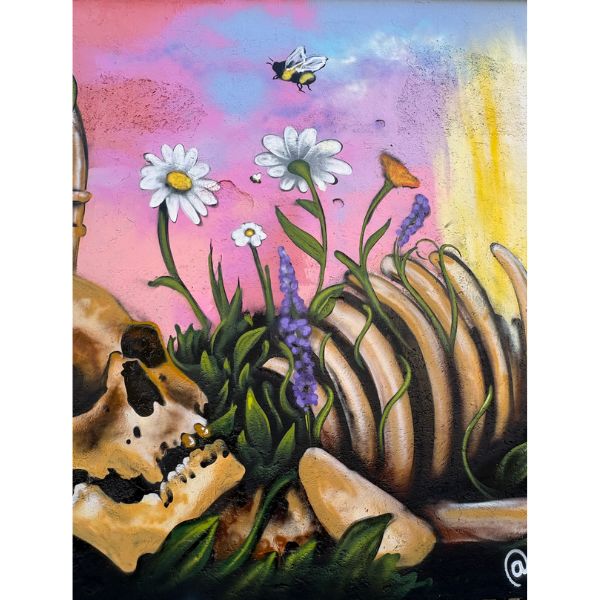
This concept is expressed through both the use of vibrant colors and elements of nature in her recent murals. Muck wanted to combine the joy of life with the inevitability of death, intentionally including both symbols of life and death in this piece. In one of these works, a golden skull is reimagined as a site for new growth, as intertwining flowers and trellises emerge from within the skull, serving as a spot where life and death coexist. The mural also depicts bright green butterflies and bumblebees that drift between the physical world and the background of the cosmic, purple galaxy, showing how death is a part of life. Muck’s commitment to this narrative is ongoing; she recently completed a smaller version of this concept in Las Cruces, blending vibrant flowers with a dark backdrop.
Overall, Muck’s body of work—spanning gritty underpasses, high-profile entertainment venues, and neighborhood walls—reflects a lifelong, unfolding dialogue with the world around her. Her signature style does more than decorate public space; it humanizes it, turning cold brick and mortar into vibrant stories of struggle, humor, faith, and resistance. Muck’s journey is no longer just about the rebellious act of putting her work on a wall; it is about an exchange between the artist, the environment, and the community. Her work demonstrates how her art not only decorates public spaces but also offers new perspectives and brings life into seemingly simple things, such as blank walls or abandoned buildings, turning them into vibrant storyboards for the community. Whether she’s turning ice from a snowstorm into a texture for a mural in Chicago or collaborating with local artists who have defaced her work, she is constantly transforming obstacles in her life into something positive, thought-provoking, and inspiring. Her work offers a rare invitation for the public to pause for a moment and think, take a breath, or take a quiet moment for themselves. For Jules Muck, the world is not merely a place to inhabit—it is a canvas to express experiences and ideas, with the ability to transform life’s toughest lessons into a vibrant celebration, one layer of paint at a time.
With those looking to follow Jules Muck’s trail of color, Muckmaps.com serves as a guide to her ever-evolving global gallery.